
Links
about
St. Anthony of Padua was born in 1195 in Lisbon, Portugal. He died on June 13, 1231 in Padua, Italy. The saint's relics rest in the Church of St. Mary of Padua. On May 30, 1232, Pope Gregory IX declared his brother Anthony a saint, and in 1946, Pope Pius XII declared him a Doctor of the Church.
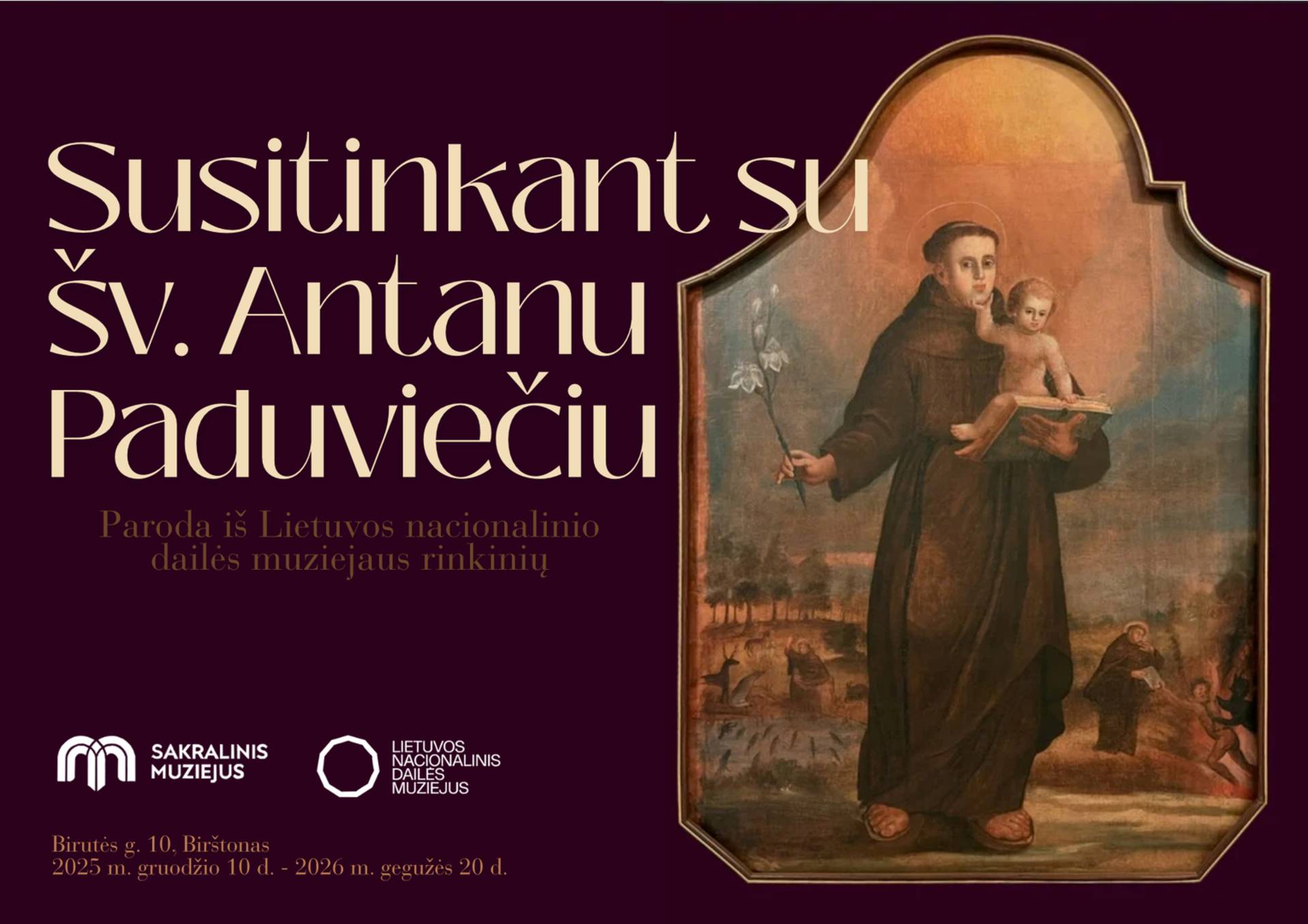
In the 18th – 19th centuries. Lithuanian Baroque art, the iconography of St. Anthony of Padua reflects the characteristic traditions of Western European depiction of saints. The saint, who lived in the thirteenth century, is loved for his eloquence as a preacher, deep spirituality and function as a patron saint. Religious paintings are the main means of spreading the cult. The iconography of St. Anthony of Padua is characterized by depicting him in a Franciscan habit, tonsure and usually with the face of a young beardless ascetic.
The attributes characteristic of St. Anthony are: a book, a lily, a cross, a flame, a flaming heart, fish, a monstrance, a donkey or mule, a jewelry box, a cross tablet with text. Until the 16th century, the saint was depicted alone and quite statically with his characteristic attributes, later his depiction transformed into a plot image telling the story of the miracle of the Child's appearance. Such a depiction is based on the saint's biographical data. The vision of the baby Jesus became widespread in works of art in the 17th century and occupies a central place in the entire iconography of St. Anthony to this day. St. Anthony's gaze on the person of Christ speaks of his constant inner prayer and the mystery of the Incarnation, Jesus' self-giving into the hands of people, emphasized in the saint's sermons.
The 18th – 20th century paintings, graphics, and small folk sculptures of the exhibition invite visitors to look not only at the depth of the content of the artistic values preserved in Lithuania, the simplicity and laconicism of folk art, but also to look for stylistic similarities and differences in the iconography of the saint. The exhibition dedicated to the patron saint of Birštonas from the collections of the Lithuanian National Museum of Art invites us to meet again and get to know St. Anthony of Padua more deeply.